
Multi-Brand Robot and Cobot Integrator
Lean audit, design, commissioning and maintenance of robotic and cobotic cells on your existing production lines. Industrial robots and cobots from UR, FANUC, Yaskawa, KUKA and Stäubli. Team based in Carquefou (Nantes, France), working on site across France and Europe.
They trust us






Definition
What is robot and cobot integration?
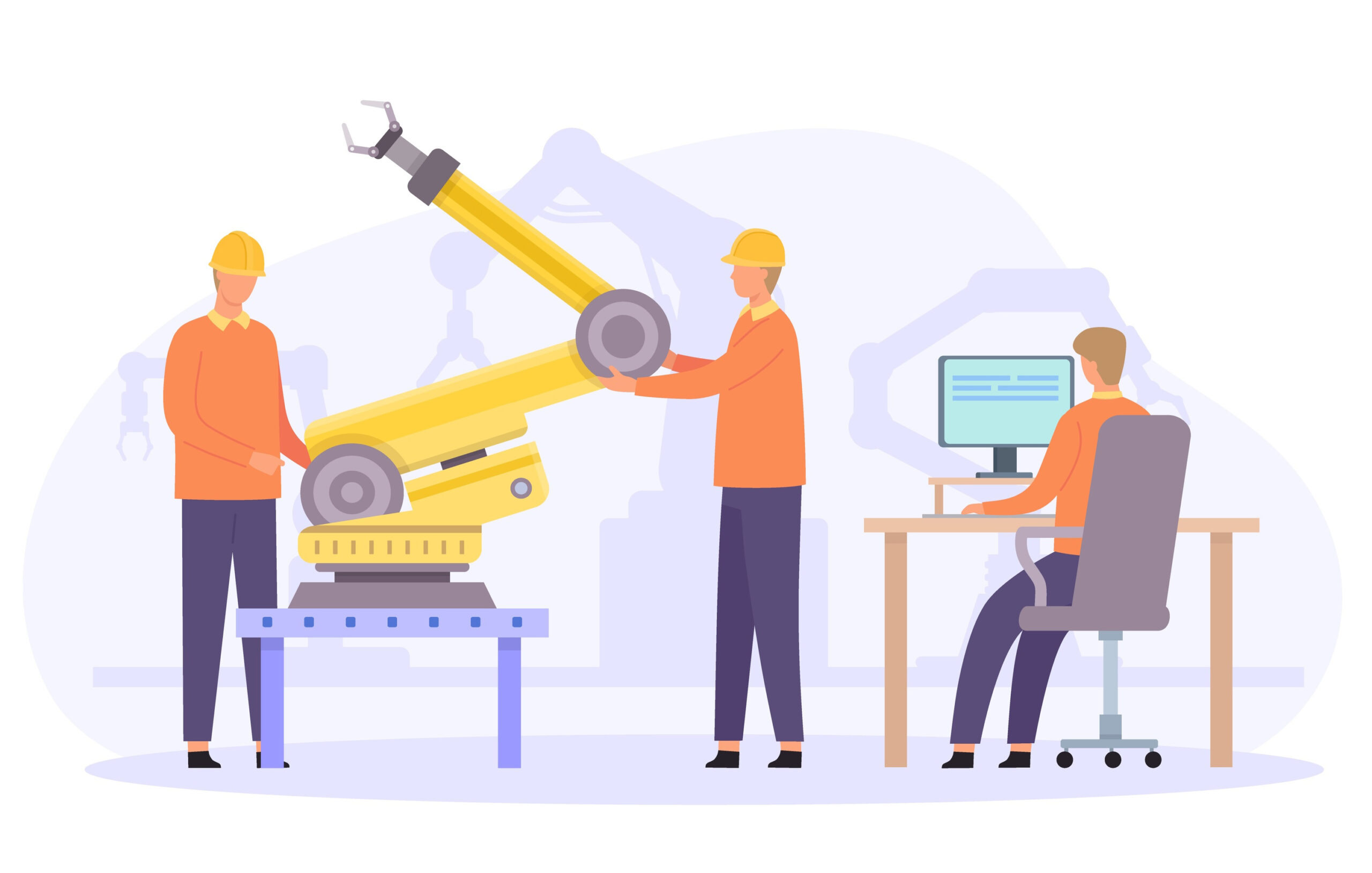
A robot integrator designs, installs and commissions complete robotic cells: they select the robot or cobot, design the gripper, integrate vision, safety and PLCs, then connect the cell to your systems (MES, ERP). The manufacturer supplies the arm; the integrator delivers a solution that produces, safely, on your line. Robot or cobot: the difference lies in how they operate. An industrial robot works behind safety guarding; a cobot shares the workspace with operators thanks to force and speed limiting.
Benefits
Why integrate robots or cobots in industry?
Four mutually reinforcing benefits. The best business cases rely on at least three of them.
At E-COBOT, we integrate both conventional industrial robots and collaborative robots; the right choice depends on your application. Industrial robots, isolated in guarded cells, remain unbeatable for high-volume, low-variability production. Cobots, on the other hand, can work in direct proximity to your operators thanks to force-limited joints and built-in torque sensors, without stopping production whenever a person approaches.
Three signals show when cobot integration becomes the right option rather than a guarded robotic cell: repetitive tasks with ergonomic risks, small to medium batch sizes, and quality variability caused by manual operations.
Applications we automate
From machine tending to intralogistics, six applications we integrate with industrial robots and cobots.

Machine loading
and unloading
Tending of machining centers, CNC lathes and plastic injection molding machines by robot or cobot. The robot runs cycle after cycle while the operator focuses on setup and inspection.

Palletizing and depalletizing
End-of-line cells for cartons, bags or crates, with pallet pattern changes in minutes. Palletizing cobots can be installed without heavy fencing when the risk assessment allows.

Assembly and screwdriving
Automated screwdriving, component insertion, seal or clip fitting. The robot guarantees the torque and traceability of every operation.

Packaging and case packing
Pick-and-place into cases, tray loading, end-of-line packaging, in food processing as well as in industry.

Vision-based quality inspection
Visual inspection, code reading, dimensional measurement with 2D or 3D cameras built into the cell. Non-conforming parts are rejected automatically.

Material handling and intralogistics
Transfer of parts between workstations and line supply, in combination with
our autonomous mobile robots
Methodology
Our 5-step integration process
Lean first, automation second. Each step comes with deliverables you approve before moving on to the next.
Lean audit
1 to 3 days on your shop floor. Value stream mapping, identification of waste.
Design
Custom cell: robot/cobot, end effector, vision, safety zones, feeders.
Engineering
CAD drawings, electrical schematics, programming. System tested in our facility before shipment.
Integration
On-site commissioning, safety testing, PLC/MES/ERP integration.
Training & support
Operator training, 12-month warranty, support contracts.
Multi-brand
The industrial robots and cobots we integrate
As an independent integrator, we recommend the platform best suited to your project, with no commercial bias.

Universal Robots
Light assembly, pick-and-place. 3-20 kg.

Fanuc
Industrial robustness, PLC integration.

Yaskawa
IP67, food processing and pharma.

Kuka
Precision, aerospace, automotive.

Stäubli
Cleanrooms, pharma, semiconductors.
Industry expertise
The industries we serve
Proven expertise in demanding industries across France and Europe.

Aerospace
Drilling, riveting, composite quality inspection. ATEX compliance, end-to-end traceability.

Automotive
EV batteries, final assembly, custom production lines.

Defense
Cybersecurity by design, audit trail, ISO 27001 on top of standard safety norms.
Electronics
Board handling, connector insertion, screwdriving. ESD-safe, fast format changes.

Plastics
Injection molding machine tending, deburring, packaging.

Food processing
Palletizing, case packing, tray loading.

Energy
Batteries, hydrogen fuel cells, power conversion. High voltage, heavy modules, long-term traceability.

Healthcare
Hospital pharmacies, biopharma. Medication preparation, intralogistics.
Why us
Why choose E-COBOT
Choosing an integrator means choosing a long-term partner.
Expertise since 2016
Know-how built cell after cell with demanding industrial customers in France and Europe.
Multi-brand, no manufacturer ties
We are not a reseller. We recommend the right robot, even when the commission is lower.
Lean at the core of our practice
Our engineers come from Lean environments. Automation amplifies a healthy process, never a wasteful one.
Made in France, present across Europe
A team of 30 people in Carquefou (Nantes). On-site support.
Our expertise also covers autonomous mobile robotics. Discover our AMR technology: proprietary SLAM algorithms, VDA 5050 compliance, and our HUSKY range designed in France.
Safety and compliance of your robotic cell
Every cell we deliver undergoes a risk assessment and comes with a compliance file. We apply ISO 10218-2 (2025 edition), which sets the safety requirements for robot system integration and now includes the requirements specific to collaborative applications. The cell is delivered with its CE marking.
From January 20, 2027, the EU Machinery Regulation (EU) 2023/1230 replaces the Machinery Directive 2006/42/EC. We support our customers through this transition, for new cells as well as for modifications to existing lines.
FAQ
Frequently asked questions
• the type of robot (cobot or industrial robot) and its payload;
• the gripper and vision system;
• the number of cells and part references to handle;
• integration with PLCs, MES and ERP;
• cell safety (guarding, safety scanners).
A firm quote is provided after the audit, with no hidden costs. To get started without a heavy investment, our HUSKY autonomous mobile robots are also available as a pay-per-use subscription.
Ready to start your cobot integration project?
A 30-minute call with our experts to assess whether your application is a good candidate, anticipate the investment and plan the next steps.